
TL;DR
Joanna Gaines’ renovation of Cottonland Castle featured a Calacatta marble slab backsplash in the kitchen and butler’s pantry. The design offers a high-end alternative to tiled backsplashes, though its cost, maintenance needs and long-term performance in a specific home are not detailed.
Joanna Gaines used Calacatta marble slabs as backsplashes in the kitchen and butler’s pantry of Cottonland Castle, a 1913 Waco, Texas, landmark renovated with her husband, Chip. A design report points to the installation as an alternative to conventional tile, pairing a historic natural stone with a contemporary kitchen finish; it does not provide project costs or a measured comparison of durability.

Get furniture and decor delivered free with Prime
- Fast, free delivery on millions of items
- Prime Video, Amazon Music and more included
- Member-only deals all year
In the renovation featured on “Fixer Upper: The Castle,” the marble backsplash rises partway up the walls above the countertops. The report describes the material as a solid slab of Calacatta marble, rather than small tiles separated by grout. In the kitchen, a marble ledge topped with brass rails and brackets adds a functional detail to the surface.
The article also points to another Gaines design, the midcentury kitchen in “Fixer Upper: The Lakehouse.” There, the marble backsplash projects outward to form a continuous ledge. The report characterizes that feature as both decorative and useful for storage, but does not give dimensions, installation specifications or details about how much weight it can support.
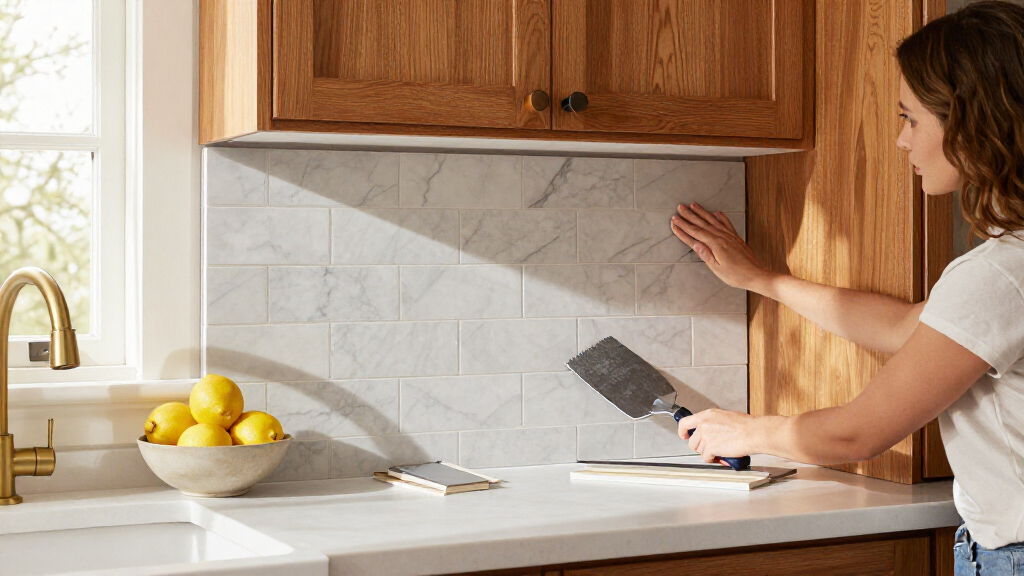
The main practical distinction is the uninterrupted surface: a slab has no tile grout lines across the backsplash area, which can make routine wiping simpler in an open kitchen layout like this modern kitchen design. Marble is a natural stone and, according to the report, typically costs more than many standard backsplash choices. No price estimates, care instructions or comparison figures are supplied, so the appeal is presented as a design argument rather than a cost analysis.
Could Marble Be Your Backsplash Upgrade?
Joanna Gaines used Calacatta marble slabs at Cottonland Castle. The look offers a grout-free alternative to tile, but costs and care requirements need checking.
A continuous stone surface
The slab backsplash rises above the countertops in the kitchen and butler’s pantry.
Brass-supported ledge
A marble ledge with brass rails and brackets adds a functional detail.
Projecting ledge
Another Gaines design uses a projecting marble ledge for storage.
Where the slab stands apart
The design examples show different ways to use marble; they do not establish which option suits every home.
- One largely continuous surface
- No grout lines across the backsplash
- Higher-end natural stone
- Grout joints between tiles
- A conventional backsplash option
- Project costs were not compared
Costs and care to check
The report provides no price estimates, care instructions or durability comparison.
- Request itemized costs for the slab, fabrication and installation.
- Ask about sealing, suitable cleaners, stains, etching and repairs.
- Discuss seams, outlets, corners, ledges and support with an installer.
- Compare the actual wall area and finish with tile and other stone options.
A historic setting
Cottonland Castle is a 1913 Waco landmark renovated by Joanna and Chip Gaines for “Fixer Upper: The Castle.”
Calacatta marble slabs pair a refreshed kitchen with the landmark’s historic character.
A different marble ledge shows another design treatment, without dimensions or support details.
A Grout-Free Finish With a Higher Price
For homeowners planning a kitchen renovation, the examples show how a backsplash can become a substantial visual feature rather than a simple protective strip behind a counter. One continuous marble surface can connect visually with a marble countertop and give a room a more unified appearance. That can be especially relevant in a renovation where the aim is to blend new work with the character of an older house, as at Cottonland Castle.
The trade-off is upfront spending. The report calls marble a higher-end natural stone but offers no local installation quotes or material measurements; the final bill would depend on the slab, fabrication, transport and installation. Its claim that marble can outlast trend-driven choices is a design judgment, not a guarantee that a particular installation will avoid damage or remain in place indefinitely.
Maintenance also matters to the decision. Fewer grout lines may reduce places where grime collects, but the feature does not establish that marble requires no care. Buyers should ask an installer about sealing, cleaning products, stain and etch risks, and repair options before comparing a slab with tile or another stone. The design’s visual longevity and the material’s day-to-day suitability are related, but they are not the same question.
Products Worth Considering

Sonos One SL (3-Pack) – Microphone-Free Speaker, Black

Levoit Vital 100S-P Air Purifier with Washable Pre-Filter

Google Nest Thermostat E with Nest Temperature Sensor Bundle, White
As an affiliate, we earn on qualifying purchases.
The Castle Renovation Behind the Design
Cottonland Castle is described as a 1913 Waco landmark that Gaines and Chip renovated for “Fixer Upper: The Castle.” Using marble in that setting supports a contrast between a material associated with long-standing architecture and a refreshed kitchen. The report links the choice to the building’s historic character, but does not provide preservation approvals or explain whether the backsplash was selected to meet any specific restoration requirement.
The article places the castle kitchen alongside Gaines’ later midcentury kitchen design in “Fixer Upper: The Lakehouse.” The two installations share marble but use different details: the castle’s backsplash has a brass-supported ledge, while the Lakehouse example uses a projecting, integrated ledge. These examples establish that a slab backsplash can suit more than one style; they do not show that all kitchens, budgets or homes would benefit from the same treatment.
Marble has a long history as a building material, as the report notes in referring to its use in ancient Greek and Roman settings. That history helps explain its association with classic design, but it does not itself establish how a modern backsplash will perform under cooking, cleaning or household wear. The specific installation and its care remain relevant.
“She bumped out the marble backsplash to create a seamless waterfall ledge that’s as beautiful as it is practical for storage.”
— Design report on the “Fixer Upper: The Lakehouse” kitchen
Costs and Care Still Need Checking
The report does not state what the Cottonland Castle installation cost, how much marble was used, or whether the stone was sealed. It also does not compare the project’s purchase and installation costs with tile over a defined period. That means its suggestion that marble can be worth the added expense remains a general design assessment, not a documented financial calculation.
Readers also cannot infer from the examples that marble is maintenance-free or suitable for every cooking area. The feature gives no testing data on stains, etching, heat exposure, cracking or repairs, and does not specify the products or routine used to care for the slabs. Those details can affect both the appearance and ownership costs of natural stone.
Finally, the article does not establish that marble is the only durable or timeless backsplash option. It mentions other natural stones as possible alternatives but names none or compares their prices. The decision depends on a homeowner’s budget, preferred look and willingness to follow the care requirements recommended for the selected stone.
Compare Slabs Before Choosing
No additional Cottonland Castle work or new Gaines backsplash announcement is identified. For readers considering a similar upgrade, the practical next step is to request itemized estimates for the slab, fabrication and installation, then compare them with tile and other natural-stone options. Estimates should be based on the actual wall area and include edge finishing, ledges and any support or installation work.
Homeowners can also ask stone suppliers and qualified installers for written care guidance, including whether the material needs sealing and which cleaners are appropriate. A sample viewed in the intended kitchen lighting can help assess color and veining, while a discussion of seams, outlets and corners can clarify how the finished surface will look. These checks can show whether Gaines’ slab approach fits a particular kitchen, rather than assuming that a television renovation translates directly to every home.
Key Questions
What marble did Joanna Gaines use at Cottonland Castle?
The design report identifies it as a solid slab of Calacatta marble, installed as a backsplash in the kitchen and butler’s pantry.
What is the main difference between a marble slab backsplash and tile?
A slab creates a largely continuous surface, while tile has grout joints. The report says the absence of grout can make wiping easier, but does not provide comparative cleaning tests or full care instructions.
Does the report say how much the marble backsplash cost?
No. It describes marble as a higher-end natural stone but gives no price, installation quote or total project budget.
Is marble guaranteed to be easier to maintain?
No such guarantee is established. The report points to fewer grout lines, but does not discuss sealing, staining, etching or cleaning products. Homeowners should ask a supplier or installer about care for the specific stone.
Where else did Gaines use a marble backsplash?
The report also describes a marble backsplash in the midcentury kitchen featured in “Fixer Upper: The Lakehouse.” It says the backsplash projects outward to create a ledge.
Source: hunker.com