
TL;DR

Get furniture and decor delivered free — and shop member deals
- Fast, free delivery on millions of items
- Access to Prime Big Deal Days deals on October 6–7
- Prime Video, Amazon Music and more included
Moving your AI workstation into a closet or away from your main space is the most effective way to reduce noise and heat. Proper ventilation and strategic treatment make it practical without major modifications. Foam absorbs reflections, but blocking sound leaks and decoupling vibrations matter most.
Picture this: your powerful AI rig hums loudly in the corner of your room, distracting you, rattling the walls, and making your workspace feel like a server farm. You want peace, a cooler setup, and a place where noise doesn’t spill into your home. Turns out, moving your rig out of the room is often the best fix. But what if your space is tight? That’s where clever placement and DIY dampening come into play.
This guide will show you how to tame noise and heat by placing your rig smartly, using acoustic dampening effectively, and even turning a closet into a quiet, cool haven. Whether you’re a hobbyist or a professional, these simple strategies will make your workspace calmer and more manageable — without breaking the bank or doing major renovations.
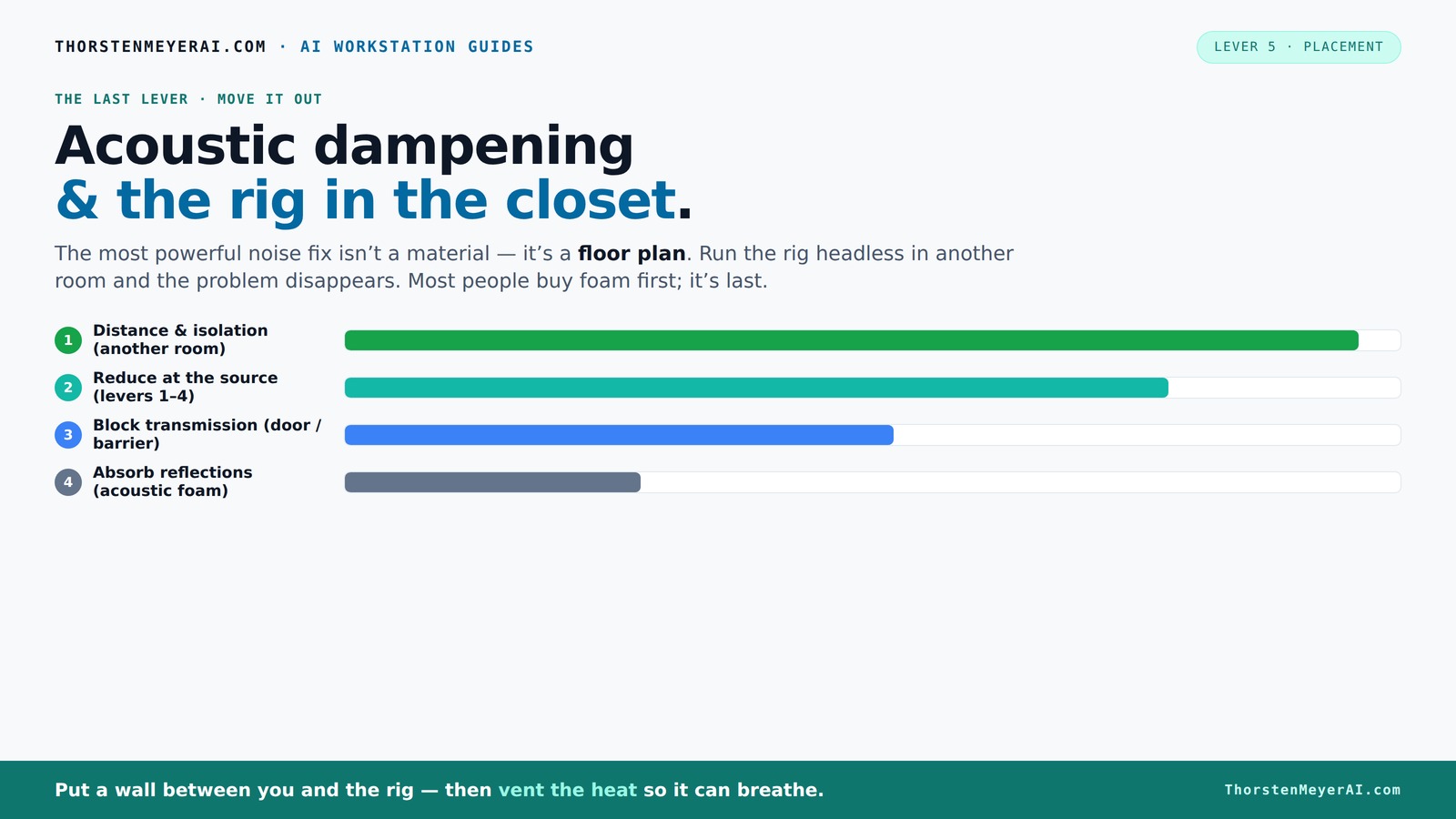
Acoustic dampening
& the rig in the closet.
The most powerful noise fix isn’t a material — it’s a floor plan. A rig you can’t hear because it’s in another room beats any amount of foam. Tap the approaches in Part 1 to see what actually works.
(another room)
(levers 1–4)
(door / barrier)
(acoustic foam)
Contain the noise, not the heat
Key Takeaways
- Moving your rig into another room or closet is the most effective noise and heat reduction method.
- Proper ventilation is critical for closet setups — without airflow, heat will build up fast. You can learn more about home improvement and ventilation solutions to optimize your setup.
- Acoustic dampening focuses on absorbing reflections, but soundproofing blocks noise leaks; both are needed for best results.
- Cover at least 20-40% of your closet surfaces with acoustic panels, especially at reflection points.
- DIY solutions like blankets, rugs, and rubber feet can cut noise significantly without big expenses.
acoustic soundproofing foam panels for computer rigs
As an affiliate, we earn on qualifying purchases.
As an affiliate, we earn on qualifying purchases.
Why Moving Your Rig Beats Soundproof Foam Every Time
Ever tried stuffing foam panels into a small space and still hearing the noise? That’s because foam only absorbs sound inside the room — it doesn’t stop noise from escaping. The most dramatic improvement comes from just moving your rig into another room or a closet. By physically relocating the machine, you eliminate a significant source of noise and heat at their origin. This is especially important because sound and heat are most intense at their source; reducing their intensity before it reaches your ears or your environment is the most direct and effective approach.
Imagine your GPU blasting away in a closet. You hear nothing. The same rig sitting on your desk? It’s a different story. The key is distance. The farther you put the machine from your workspace, the less you notice its noise. Additionally, heat dissipates more effectively when the rig isn’t confined in a small, enclosed space, preventing overheating and throttling that can degrade performance over time.
Plus, with a network connection, you don’t need to be next to your rig to use it. SSH or remote desktop makes it easy to control a rig tucked away in a basement or spare room, turning noise into a non-issue. This simple move often beats expensive soundproofing or dampening solutions because it addresses the root causes—noise and heat—directly and efficiently. The tradeoff is the need for reliable remote access and a bit of initial setup, but in terms of long-term comfort and performance, it’s often worth it.
quiet computer case for noise reduction
As an affiliate, we earn on qualifying purchases.
As an affiliate, we earn on qualifying purchases.
The 'Rig in the Closet' Setup — How to Do It Right
Placing a high-power, heat-generating machine inside a closet sounds perfect for noise reduction. But without proper ventilation, it’s a recipe for overheating. Think of it like a car engine — sealed in a garage with no airflow. It’ll overheat fast and risk damaging your hardware. The key is to design a setup that balances cooling with soundproofing, ensuring your rig stays safe and quiet.
To make a closet rig work effectively, you need to plan for airflow that removes hot air while minimizing noise escape. Installing passive vents or ducted exhaust fans allows hot air to exit without creating additional noise pathways. Use thermostatic control on fans to ensure they operate only when necessary, conserving energy and reducing noise further. Consider a purpose-built soundproof cabinet with active cooling — these combine acoustic lining with cooling fans that won’t wake the neighbors. The challenge is to prevent heat buildup while maintaining a low noise profile, which requires careful placement of vents, fans, and insulation.
For example, a creator built a custom closet rig with a small duct fan and vents, keeping temperatures stable and noise down below 30dB — quiet enough to record vocals in the same room.[1] Regularly monitor your temperatures and adjust ventilation as needed. For tips on maintaining optimal airflow and noise reduction, visit this resource. The tradeoff here is complexity: effective cooling requires planning and sometimes custom fabrication, but the payoff is a safe, quiet, and efficient setup that doesn’t compromise hardware longevity or your peace of mind.
As an affiliate, we earn on qualifying purchases.
Acoustic Dampening 101: Absorb, Block, Decouple
Acoustic dampening isn’t just about foam — it’s about understanding what sound you want to control and why. Learn more about effective sound treatment at this site. There are two main types of noise: airborne and structure-borne. Each needs a different fix, and understanding this distinction is crucial for effective treatment. Airborne noise, such as the hum and whine from fans and GPUs, travels through the air and can easily escape through gaps or thin barriers. Structure-borne noise, on the other hand, is transmitted through solid surfaces like the desk or floor, causing vibrations that radiate outward as sound.
Airborne noise is best tackled with acoustic panels placed at first reflection points — the spots where sound bounces off walls and surfaces near your mic or speakers. Proper placement here prevents echoes and flutter that can muddy recordings. Think of it as softening echoes in a canyon, making the sound more natural and less harsh.
Structure-borne noise travels through the rig’s physical contact with surfaces, causing vibrations that radiate as sound. The fix? Decouple it with rubber feet, anti-vibration mounts, or isolation pads. These break the path of vibrations, preventing them from traveling into the environment and causing low-frequency rattle or boomy sounds. This is especially important for low-end control and reducing the 'boxy' or 'boomy' sound in recordings.
For instance, a streamer used rubber grommets under his tower and placed foam at reflection points — he cut his noise leakage by 70% and reduced low-frequency rattle.[2] Combining absorption and decoupling strategies ensures a more balanced and effective noise reduction, addressing both echoes and vibrations for a cleaner, quieter setup.
computer heat and noise insulation materials
As an affiliate, we earn on qualifying purchases.
As an affiliate, we earn on qualifying purchases.
How to Cover Your Closet for Maximum Sound Control
In a small closet, more is usually better when it comes to acoustic treatment. For detailed guidance, check out this article. Covering 20-40% of the walls with absorption panels reduces echo and flutter, making your recordings clearer and more professional. But it’s not just about quantity — placement matters deeply. Properly positioned panels at reflection points intercept sound waves where they bounce, preventing echo buildup and creating a more natural sound environment. For full control, aim for near-complete coverage, especially on the walls closest to your mic and speaker, but be mindful of not overloading the space which can cause a 'dead' sound or muffling.
Here’s a quick plan:
- Place bass traps in the corners to tame low-end rumble, which tends to build up in small enclosed spaces and can muddy recordings if left unaddressed.
- Line the side walls and the back wall with acoustic panels — especially at first reflection points identified by a mirror trick or acoustic calculations. These spots are where sound reflects directly into your mic, so treating them reduces flutter echo and improves clarity.
- Cover the ceiling above your head if possible, since sound reflects down onto your mic, contributing to room tone and reverberation.
- Seal gaps around the door and vents with weatherstripping or acoustic sealant to prevent sound leaks that compromise your treatment efforts. Small cracks can significantly undermine your acoustic integrity.
For example, a home voiceover artist used about 60% coverage in her closet booth, adding foam panels, bass traps, and sealing gaps — her recordings became studio-quality in a tiny space.[4] Achieving this level of coverage requires balancing treatment with practicality, but the payoff is a much more controlled, professional sound environment that minimizes room coloration and external noise.
Cheap Tricks for a Quiet, Cool Closet Rig
On a budget? You can still make your closet setup much quieter and cooler with simple, affordable solutions. Use moving blankets or thick rugs to soften reflections and absorb flutter echo — these materials are inexpensive, readily available, and easy to deploy. They help prevent sound from bouncing around the small space, reducing echo and overall noise levels.
Some quick tips:
- Hang blankets over the door or walls to block sound leaks, especially if the closet has gaps or thin doors.
- Place a dense rug or foam mat under your rig for vibration decoupling, which reduces structure-borne noise and low-frequency rattle.
- Use a small, quiet exhaust fan with ducting for ventilation, ensuring good airflow without introducing additional noise.
- Seal gaps around outlets and vents with weatherstripping or acoustic tape to prevent sound leaks that can undermine your treatment.
This DIY approach can cut noise by 50-60% and keep temperatures manageable, making it a practical solution for beginners or those on a tight budget. While not as perfect as professional treatment, these tricks significantly improve the environment without major expense or effort.
The Big Picture: When Do You Need Real Soundproofing?
Acoustic dampening and strategic placement tricks help a lot, but sometimes, you need real soundproofing. If your rig’s noise leaks into other rooms, disturbs neighbors, or if you require absolute silence for professional recordings, basic treatments won’t suffice. In these cases, investing in true soundproofing becomes necessary. This involves sealing all gaps, adding dense materials like mass-loaded vinyl, and constructing a soundproof enclosure.
Think of it like creating a dedicated soundproof room inside your house. You’ll need heavy-duty barriers, airtight seals, and possibly professional help to achieve total silence. The tradeoffs include higher costs, increased complexity, and longer setup times, but the result is a space where external noise is minimized to negligible levels.
For example, a musician with a home studio installed a double drywall wall with damping compound and airtight doors, dropping noise levels by over 90%. This level of treatment is ideal for recording sessions where external noise or sound bleed could ruin professional quality. The key is to assess your needs: if noise isn’t an issue, basic dampening and placement are enough; but if silence is critical, investing in full soundproofing is justified despite the higher effort and expense.
Your Action Plan: Making Your Closet Rig Work for You
Start with the basics: move your rig into a closet or separate room. Add ventilation to keep it cool. Cover reflective surfaces with foam or blankets. Seal gaps around doors and outlets. Then, test and tweak until you find the optimal setup that balances noise reduction and cooling efficiency.
If needed, upgrade with bass traps, dense materials, or professional soundproofing. Remember, the goal isn’t necessarily to turn your closet into a professional studio but to make the noise manageable and the environment safe for your hardware. Prioritize safety and comfort while maintaining performance.
For example, a podcaster combined budget blankets with strategic panel placement and a small exhaust fan, turning a closet into a quiet, cool recording space. It’s all about layering solutions—each step adds to the overall effectiveness, creating a space that’s both functional and peaceful.
Frequently Asked Questions
How much acoustic treatment do I need for a closet setup?
Generally, covering 20-40% of the walls with acoustic panels is enough for small closet booths. Focus on first reflection points and corners for bass traps. More coverage equals better sound control, but even partial treatment makes a noticeable difference.Can I just put my rig in a closet without ventilation?
No, that’s a bad idea. Sealed spaces trap heat quickly, risking overheating and throttling. Always include passive vents or exhaust fans to keep temperatures stable and prevent damage.What’s the difference between dampening and soundproofing?
Dampening absorbs reflections and reduces echo inside a room, making recordings clearer. Soundproofing blocks outside noise from entering or leaving a space. For a small closet, combining both strategies yields the best results.Are foam panels enough for a closet booth?
Foam panels are great at controlling reflections, but they don’t block sound leakage. For noise isolation, add sealing around doors and consider dense materials or barriers if outside noise is a problem.How do I prevent my closet from sounding 'boxy' or 'boomy'?
Use bass traps in corners and cover hard surfaces with foam or blankets. Proper placement of absorbent materials at reflection points reduces the 'boxy' sound and creates a more natural, balanced tone.Conclusion
Sometimes, the best move isn’t to fight the noise — it’s to move the rig away from your workspace entirely. Combine that with smart dampening and ventilation, and suddenly, your closet becomes a quiet, cool sanctuary for AI work or voice work. It’s a simple shift that pays off in peace, performance, and productivity.
Think of your space as a tool — use placement and DIY tricks to tame the noise and heat, letting your work shine without distraction or overheating. Your perfect quiet setup is closer than you think.
Fall Picks
fall essentials
As an affiliate, we earn on qualifying purchases.